JillLebofsky may earn a commission if you buy through links on this page, at no extra cost to you. That does not change what we report.
Part of our Nerve Soothe overview. Last checked October 28, 2026.
Nerve Soothe benefits, going by published research, come down to possible mild help with calm and sleep from one herb, passionflower; none of the five label herbs has a human trial for peripheral neuropathy. The best trial behind any ingredient is a 36-patient pilot study in which passionflower drops matched oxazepam for anxiety[1]. The other four herbs rest on animal, cell or unrelated human work.
What are the real Nerve Soothe benefits?
The real Nerve Soothe benefits are unproven for nerve pain. The vendor calls Nerve Soothe "the only product that has been scientifically proven to stabilize neuropathy permanently", yet its FAQ cites no trial of the product. Its references are a faculty profile, a Mayo page, rat and cell studies and a 1977 nutrition abstract[2]. We found no published study of the 900 mg blend itself.
What the label herbs can show is narrower. Passionflower has small human trials for anxiety and sleep, and a group of nine trials mostly reported less anxiety[3]. Prickly pear has mixed human data on blood sugar, blood pressure and body fat[4]. Marshmallow, Corydalis and California poppy have no human trial for nerve pain in the sources we read.
So the honest list of possible benefits is short: a modest calming or sleep effect is plausible, and the rest of the sales letter's promises have no human evidence behind them.
What does the evidence show for each claimed benefit?
The evidence shows that each benefit the vendor names lacks human data for this formula, and only calm and sleep have even small trials for one ingredient. The table sets each vendor claim next to what the studies in our sources found.
| Claimed benefit (vendor) | What the studies show | Evidence grade |
|---|---|---|
| "Control your neuropathy for life"[2] | No human trial of any of the five herbs for peripheral neuropathy. Neuralgia is a traditional passionflower use only[5]. | Weak |
| Blocks "the three enzymes" COX-2, PGE-2 and MMP-13[6] | No human data offered. Corydalis pain claims rest mostly on animal and cell work[7]. | Weak |
| Calmer mood (not a headline claim) | Passionflower: most of 9 trials reported less anxiety; trials are methodologically weak[3][5]. | Limited |
| Better sleep (not a headline claim) | Passionflower raised total sleep time on polysomnography in 110 adults with insomnia[8]. | Limited |
| "Diabetes busting ingredients"[2] | Prickly pear pads (cladode) show promise for glucose; fruit products mostly had no effect; high risk of bias[9]. | Weak |
| "Help you lose weight"[10] | Prickly pear meta-analysis: no effect on body weight[4]. | Weak |
Why ingredient studies do not carry over to this capsule
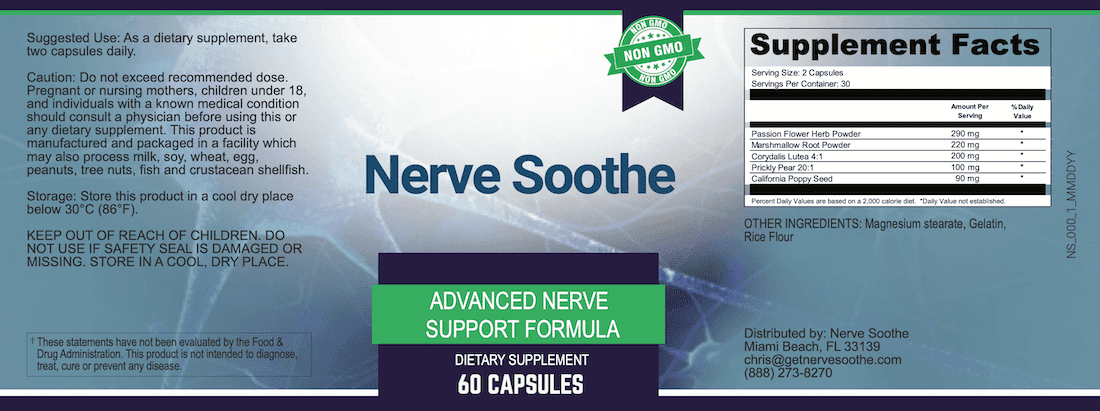
The passionflower trials used 45 drops a day of extract, a cup of tea at night, or a standardized extract at bedtime[1][11][12]. Nerve Soothe uses 290 mg of dried passionflower herb powder, a different form with no matching dose in those studies[13].
The label also lists Corydalis lutea, while the sales letter describes Corydalis yanhusuo, a different species[6]. The corydalis research we read covers yanhusuo only. Our Nerve Soothe ingredients dose comparison goes through all five amounts.
What does NCCIH say about passionflower?
The US National Center for Complementary and Integrative Health (NCCIH) says passionflower has only a small amount of research behind it and that its conclusions are not definite. It also says there is not enough evidence for pain conditions such as fibromyalgia.
On safety, NCCIH says the extract may be safe for up to 8 weeks, with drowsiness, dizziness and confusion as possible effects. So even the best-studied herb in Nerve Soothe offers a modest, uncertain benefit for calm and none shown for nerve pain.
Do the other four herbs add a benefit?
Only weakly, and not for nerves. Marshmallow root's human data cover cough and sore throat mixes and a skin ointment for children with eczema[14][15]. California poppy calmed mice, and its one human trial mixed it with hawthorn and magnesium, so its own effect is unknown[16][17].
Corydalis research covers yanhusuo, mostly in animals and cells, and says nothing direct about the lutea on this label[18]. Prickly pear's glucose and blood pressure findings came from small, inconsistent trials using other doses[9].
The prescription drug framing
The sales letter says Lyrica, gabapentin and Lipoderm "just masked his pain", and a testimonial says the buyer is "completely off my meds"[6][2]. None of the herbs has evidence that would justify that switch. If you take prescribed nerve medicine, keep taking it as prescribed and raise any supplement with the prescriber first.
What should you check before buying?
Check five things before buying, because the benefits are uncertain and two herbs can make you drowsy.
- Your goal. If you want relief from diagnosed neuropathy, no label herb has a human trial for it.
- Your medicines. Passionflower and California poppy may add to the effect of sedatives[19]. Ask a pharmacist; see our Nerve Soothe side effects guide.
- Pregnancy. NCCIH advises avoiding passionflower in pregnancy because it may cause uterine contractions.
- The refund terms. The sales page promises money back "even if the container is completely empty", but the terms cover "any defective product" and returns must arrive within 60 days of purchase[2][20].
- The price. The vendor order form, checked October 28, 2026, starts at $138 for 2 bottles. Our price and coupon page has the full ladder.
Our take
Nerve Soothe may help a little with calm or sleep, mainly through passionflower, but no study of the product or its herbs shows a benefit for neuropathy. Read the "scientifically proven" wording as a vendor claim, since no trial of the formula is cited. If you still want to try it, buy the smallest order, keep any prescribed medicine as your doctor directed, and do not drive until you know how the capsules affect you. Our legitimacy check covers the seller.
Back to the Nerve Soothe overview.
Frequently asked questions
Does Nerve Soothe help with neuropathy pain?
No published study shows that. None of the five herbs on the Nerve Soothe label, passionflower, marshmallow root, Corydalis lutea, prickly pear or California poppy, has a human trial for peripheral neuropathy in the sources we read. The vendor cites animal, cell and unrelated studies.
Can Nerve Soothe help me sleep?
Possibly a little. Passionflower, the largest ingredient at 290 mg, raised total sleep time in a trial of 110 adults with insomnia. That study used an extract, so the 290 mg herb powder in Nerve Soothe is not a matched dose.
How long does Nerve Soothe take to work?
No study of Nerve Soothe exists, so there is no measured timeline. Passionflower trials ran from 7 days for tea to 4 weeks for extract drops. NCCIH says passionflower extract may be safe for up to 8 weeks of use.
Is Nerve Soothe a replacement for gabapentin or Lyrica?
No. The sales letter frames those drugs as masking pain, but no herb on the label has evidence for nerve pain. Keep taking prescribed medicine as directed and ask the prescriber or a pharmacist before adding any supplement.
Does Nerve Soothe lower blood sugar?
The vendor mentions diabetes busting ingredients. Prickly pear pads showed some promise for glucose, while fruit products mostly showed no effect, and the label does not say which part is used. Anyone on diabetes medicine should ask a pharmacist first.
Sources
- Passionflower vs oxazepam for generalized anxiety, pilot randomized trial (PMID 11679026). PubMed, read October 20, 2026.
- Nerve Soothe video sales page with FAQ. Nerve Soothe vendor, read October 28, 2026.
- Nine passionflower trials for anxiety, systematic analysis (PMID 33352740). PubMed, read October 20, 2026.
- Prickly pear and body weight, fat, blood pressure and cholesterol, meta-analysis of randomized trials (PMID 25837206). PubMed, read October 20, 2026.
- Passionflower: traditional uses and quality of the clinical trials (PMID 24140586). PubMed, read October 20, 2026.
- Nerve Soothe sales letter, text version. Nerve Soothe vendor, read October 28, 2026.
- Corydalis alkaloids and pain, pharmacology summary (PMID 34946576). PubMed, read October 20, 2026.
- Passionflower and sleep in 110 adults with insomnia, randomized trial (PMID 31714321). PubMed, read October 20, 2026.
- Prickly pear (Opuntia) and glucose, systematic analysis (PMID 31096667). PubMed, read October 20, 2026.
- Nerve Soothe About page. Nerve Soothe vendor, read October 28, 2026.
- Passionflower tea and subjective sleep quality (PMID 21294203). PubMed, read October 20, 2026.
- Passionflower extract, stress and sleep in 65 adults, randomized trial (PMID 38646244). PubMed, read October 20, 2026.
- Nerve Soothe Supplement Facts label image. Nerve Soothe vendor, read October 28, 2026.
- Marshmallow root mucilage, cough and sore throat, research summary (PMID 31770755). PubMed, read October 20, 2026.
- Marshmallow 1% ointment vs hydrocortisone 1% in childhood atopic dermatitis, pilot trial (PMID 33034099). PubMed, read October 20, 2026.
- California poppy sedative and anxiolytic effects in mice (PMID 1680240). PubMed, read October 20, 2026.
- Hawthorn, California poppy and magnesium combination for mild to moderate anxiety, randomized trial (PMID 14741074). PubMed, read October 20, 2026.
- Corydalis yanhusuo pharmacology and safety, research summary (PMID 32223481). PubMed, read October 20, 2026.
- California poppy, peripheral analgesic and sedative effects in mice (PMID 11507727). PubMed, read October 20, 2026.
- Nerve Soothe terms and refund policy. Nerve Soothe vendor, read October 28, 2026.
This page is general information, not medical advice. Dietary supplements are not reviewed by the FDA for safety or effectiveness before they are sold and are not intended to diagnose, treat, cure or prevent any disease. Talk to your doctor before taking any supplement, especially if you are pregnant, nursing, take medication or have a health condition.