JillLebofsky may earn a commission if you buy through links on this page, at no extra cost to you. That does not change what we report.
Part of our Nerve Soothe overview. Last checked October 28, 2026.
Nerve Soothe side effects most likely to matter are drowsiness, dizziness and confusion, because two of its five herbs, passionflower and California poppy, have sedating effects. NCCIH lists all three for passionflower, and in the one human trial that included California poppy, mostly mild digestive complaints occurred in 11.5% of users against 9.7% on placebo[1]. Liver and drug interaction questions also apply.
Is Nerve Soothe safe? Safety at a glance
Nerve Soothe has no published safety study of its own, so its safety rests on what is known about its five herbs, and the biggest caution is sedation. Passionflower and California poppy can add to the effect of sleep medicines, anxiety medicines and anesthesia[2]. Do not drive or operate machinery until you know how the capsules affect you.
The vendor says it has been "taken by thousands of folks with no reported side effects" and is "Safe for those with sensitive health conditions"[3][4]. No safety data back those lines.
On the record side, a search of the FDA's openFDA recall and adverse event (CAERS) databases for "nerve soothe" returned no matches on October 28, 2026. An empty search means no reports were filed under that name; it does not prove the product is free of side effects.
What side effects are possible?
Possible side effects fall into three groups: stomach upset, sleepiness or sensitivity reactions, and effects that come from mixing the herbs with medicines.
Digestive
Prickly pear trials reported gastric intolerance and flu-like symptoms[5]. In the hawthorn, poppy and magnesium trial, side effects were mostly mild and digestive[1].
Drowsiness and sensitivity
NCCIH lists drowsiness, dizziness and confusion for passionflower, and California poppy acted as a sedative in mice at higher doses[6]. People who already feel tired, older adults and anyone prone to falls should take extra care. The capsule shell is gelatin, an animal product, which matters for those who avoid it[7].
Medication-related
California poppy extract and its alkaloids blocked four drug-processing liver enzymes, CYP3A4, 2C9, 2C19 and 2D6, in lab tests; a water tea did not[8]. That could change blood levels of some medicines, which is why a pharmacist check matters.
Which ingredients deserve extra attention?
Passionflower, California poppy and corydalis deserve the most attention, for sedation, drug processing and liver reasons; prickly pear matters for people on diabetes or blood pressure drugs.
| Ingredient (label dose) | Safety issue | Why it matters |
|---|---|---|
| Passionflower (290 mg) | Drowsiness, dizziness, confusion (NCCIH) | Adds to sedatives and anesthesia; avoid in pregnancy; stop 2 weeks before surgery |
| California poppy seed (90 mg) | Sedative in mice, acting at benzodiazepine receptors[6][2] | May add to benzodiazepines and sleep aids; blocked CYP enzymes in lab tests[8] |
| Corydalis lutea 4:1 (200 mg) | The yanhusuo alkaloid l-THP blocks dopamine D1 and D2 receptors[9] | Possible added effect with sedatives, antipsychotics and dopamine drugs (theoretical); liver caution below |
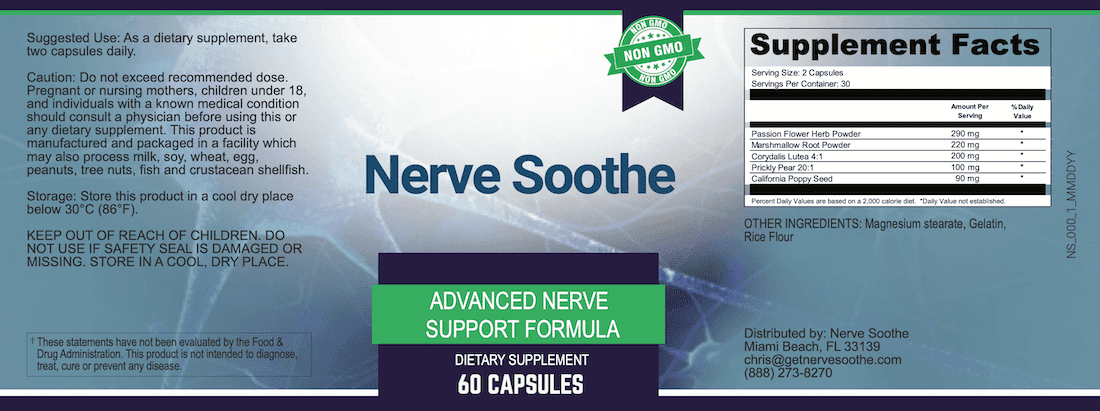
| Prickly pear 20:1 (100 mg) | Gastric intolerance; flu-like symptoms[5] | May add to diabetes and blood pressure drugs (not studied directly)[10] |
| Marshmallow root (220 mg) | No lactation safety data; quality varies by product[11] | No interactions documented in the sources we read |
The liver question
Jin Bu Huan, a Chinese pain product, caused acute hepatitis and biopsy-proven chronic hepatitis[12][13]. Its link to corydalis comes from literature on the alkaloid l-THP, not from those case reports, and reviewers say corydalis activity "remains a concern"[14]. All of that research is on yanhusuo; the sources we read do not say whether the Corydalis lutea in Nerve Soothe contains l-THP. People with liver disease should ask a doctor first.
Which medicines could interact?
Medicines that cause sleepiness, act on dopamine, lower blood sugar or blood pressure, or are cleared by CYP liver enzymes could interact. These are the groups to show a pharmacist:
- Sleep medicines, anxiety medicines and benzodiazepines (passionflower, California poppy)[2]
- Anesthesia and other sedating drugs used around surgery (passionflower, per NCCIH)
- Antipsychotics and dopamine drugs, such as some Parkinson's medicines (corydalis l-THP, theoretical)[9]
- Diabetes and blood pressure medicines (prickly pear)[10][5]
- Any medicine processed by CYP3A4, 2C9, 2C19 or 2D6 (California poppy, lab data)[8]
If you take a prescription for nerve pain, keep taking it as prescribed. Ask the prescriber or pharmacist whether adding sedating herbs makes sense, and read the sales letter's line that those drugs "just masked his pain" as the vendor's marketing[4].
Pregnancy, breastfeeding and who should ask a doctor first
Ask a doctor before taking Nerve Soothe if any of these apply:
- You are pregnant or trying to conceive: NCCIH advises avoiding passionflower, which may cause uterine contractions.
- You are breastfeeding: LactMed lists no lactation safety data for marshmallow[11].
- You have surgery planned: stop passionflower 2 weeks before.
- You have liver disease or abnormal liver tests.
- You have diabetes or take blood pressure medicine.
- You take any medicine listed above, or several medicines.
- Your numbness or pain has no diagnosed cause yet. See our Nerve Soothe benefits page for what the herbs can and cannot do.
Which symptoms need a doctor right away?
Stop the capsules and get medical help right away if you notice any of these:
- Yellow skin or eyes, dark urine, or pain in the upper right belly
- Severe drowsiness, confusion, fainting or trouble staying awake
- Swelling of the face, lips or throat, hives, or trouble breathing
- Sudden weakness, new numbness that spreads quickly, or trouble walking
- A foot sore or wound that does not heal or looks infected
- Very low blood sugar signs, such as shaking, sweating and confusion, if you take diabetes medicine
For an emergency in the US, call 911.
Safety conclusion
Nerve Soothe has no safety study of its own, and drowsiness is its clearest risk. The herbs can add to sedatives and may affect how some drugs are processed, and corydalis carries a liver question. Check your medicines with a pharmacist, skip it in pregnancy, and keep any prescribed nerve medicine as directed. Our Nerve Soothe ingredients guide has every dose and our complaints page covers buyer reports.
Back to the Nerve Soothe overview.
Frequently asked questions
Does Nerve Soothe make you sleepy?
It can. Passionflower, at 290 mg the largest ingredient, can cause drowsiness, dizziness and confusion according to NCCIH, and California poppy acted as a sedative in mice. Avoid driving until you know how two capsules affect you.
Can I take Nerve Soothe with gabapentin?
Ask your prescriber or pharmacist first. Passionflower and California poppy can add to the effect of sedating medicines. Keep taking gabapentin or any other prescribed nerve medicine as directed; the herbs have no evidence that would justify a switch.
Is Nerve Soothe bad for the liver?
The FDA adverse event database had no reports under the Nerve Soothe name. A Chinese pain product, Jin Bu Huan, caused hepatitis, and its link to corydalis comes from l-THP literature on Corydalis yanhusuo. The label lists Corydalis lutea, which our sources do not cover.
Can I take Nerve Soothe while pregnant?
NCCIH advises avoiding passionflower in pregnancy because it may cause uterine contractions, and passionflower is the largest ingredient in Nerve Soothe. Marshmallow has no lactation safety data. Talk to your doctor before taking any herbal blend while pregnant or breastfeeding.
Has the FDA received complaints about Nerve Soothe?
A search of the openFDA adverse event (CAERS) and recall databases for nerve soothe returned no matches on October 28, 2026. That means nothing was filed under that name, which is different from proof that no side effects occur.
Sources
- Hawthorn, California poppy and magnesium combination for mild to moderate anxiety, randomized trial (PMID 14741074). PubMed, read October 20, 2026.
- California poppy, peripheral analgesic and sedative effects in mice (PMID 11507727). PubMed, read October 20, 2026.
- Nerve Soothe video sales page with FAQ. Nerve Soothe vendor, read October 28, 2026.
- Nerve Soothe sales letter, text version. Nerve Soothe vendor, read October 28, 2026.
- Prickly pear and body weight, fat, blood pressure and cholesterol, meta-analysis of randomized trials (PMID 25837206). PubMed, read October 20, 2026.
- California poppy sedative and anxiolytic effects in mice (PMID 1680240). PubMed, read October 20, 2026.
- Nerve Soothe Supplement Facts label image. Nerve Soothe vendor, read October 28, 2026.
- California poppy extract and alkaloids, CYP enzyme inhibition and PXR activation in vitro (PMID 27054913). PubMed, read October 20, 2026.
- l-Tetrahydropalmatine, a dopamine D1/D2 antagonist (PMID 22300097). PubMed, read October 20, 2026.
- Prickly pear (Opuntia) and glucose, systematic analysis (PMID 31096667). PubMed, read October 20, 2026.
- Marshmallow in LactMed, drugs and lactation database (PMID 30000899). PubMed, read October 20, 2026.
- Acute hepatitis linked to Jin Bu Huan, case reports (PMID 7741903). PubMed, read October 20, 2026.
- Chronic hepatitis linked to Jin Bu Huan, biopsy-proven case (PMID 9537855). PubMed, read October 20, 2026.
- Corydalis yanhusuo pharmacology and safety, research summary (PMID 32223481). PubMed, read October 20, 2026.
This page is general information, not medical advice. Dietary supplements are not reviewed by the FDA for safety or effectiveness before they are sold and are not intended to diagnose, treat, cure or prevent any disease. Talk to your doctor before taking any supplement, especially if you are pregnant, nursing, take medication or have a health condition.